It has been three weeks since I arrived at Kigali’s tiny international airport and first set my foot on African soil. Even though expats living here are telling me how much of an easy start into Africa Rwanda is, I have found myself amazed and sometimes also overwhelmed by how different it is from other developing countries I have seen so far. Kigali on the one hand side is entirely modern, especially when strolling around the Convention Centre, a dome visible from afar by its lights in Rwanda’s national colours green, yellow, and blue, which stand for peace, economic development, and the hope for prosperity respectively. The nearby shopping centre Kigali Heights offers Starbucks look-alike cafés and Italian ice cream besides well equipped supermarkets.

But then in the valleys between the small hills that the city is build on, there is plenty of wasteland, unpaved roads, and dwell-like settlements. When I hop on one of the infamous motorbike taxis to get to work, I am still surprised each day how the drivers manage to navigate their bikes across the deep, water-paved gullies and puddles that are building up during the raining season. Along those unpaved roads the local life is bubbling, especially as soon as the sun goes down around 6pm everyone seems to be hanging around the tiny shops that are offering staples, haircuts, or alcoholic drinks.

Orientation and getting around in a city that only a couple of years ago received consistent street numbering remains a challenge I entirely underestimated. Motor-taxi drivers barely understand English, they do not know street names, and so far I have not found anyone being able to read maps. Hence getting to a destination requires becoming creative – either you name a place close by that they know (like a restaurant or hotel) or you navigate them with your smartphone in your hand while holding the balance on the back seat.
In general, the level of English knowledge depends a lot on the age and education level of Rwandese. Compared to other East African countries, the country was not a former British colony such as Uganda, Kenya, and Tanzania, and the population of Rwanda had one consistent local language (Kinyarwanda), making it unnecessary to learn the language in order to communicate in everyday life. The older generation studied French in school and only ten years ago the official decision was taken to switch to English as an affront against its the former colonial powers and strained relationships with France – even leading to Rwanda becoming a part of the Commonwealth in 2009.
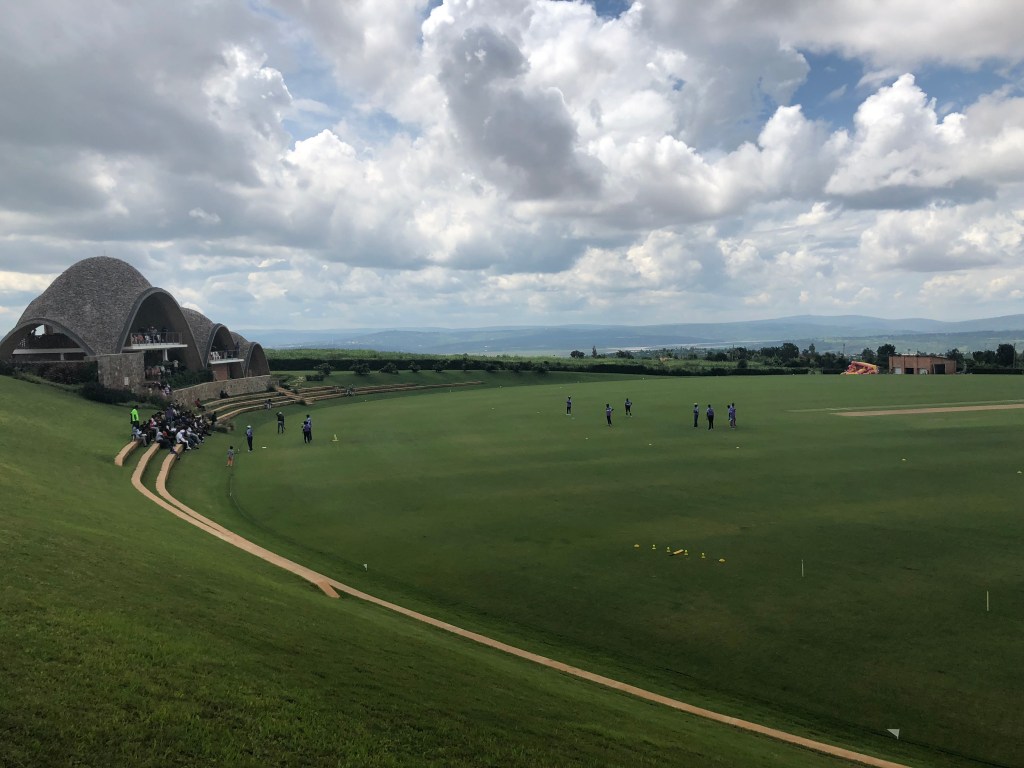
In wake of this development, the barely known Commonwealth sport cricket gained further momentum since returnees from neighbouring countries brought it back after the genocide – and became a means of healing wounds by re-installing trust and team spirit. On my very first weekend here, I have joined my British housemate to watch a game at the newly build cricket stadium – one of the nations most recent pride and nominated for an architectural award. Hard to find at the end of a dirt road half an hour from the city centre, it impresses with its elegant looking three consecutive domes of varying sizes, purely made from handmade stacked tiles, that host a bar and additional seating opportunities besides the grass humps making up the sides of the playing field. In the background, one of the few plain areas of the country unfold where the new Bugesera International Airport is getting built, since the old one is becoming too small and expansion is impossible due to the hilly surrounding.
The largest of those hills around the city is Mount Kigali with an elevation of 1,850 meters, which I decided to jog down in some youthful enthusiasm, which let me to breathlessly give up at the foot of the hill half an hour later in the neighbourhood of Nyamirambo – one of the oldest ones with a large Muslim population and a bustling night life. Luckily, the Nyamirambo Women’s Center offered me a good excuse to stop and join in on one of their daily walking tours. The center was found in 2007 by local women to address gender-based violence, gender inequality and discrimination.
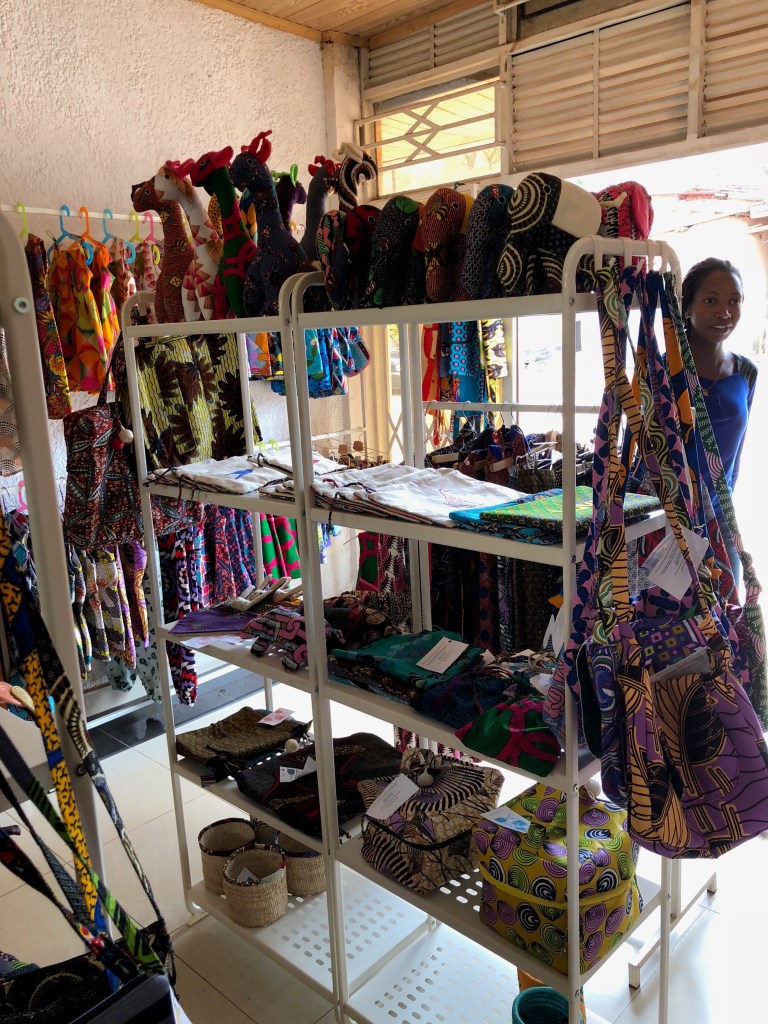
Besides offering vocational training in sewing and selling the beautiful handmade dresses, baskets, and other accessories in their shop, they also teach tourists about the neighbourhood by showing them local shops and markets. I learned how hairdressers braid in extensions in various styles, viewed how to iron with an ancient coal-based iron, and helped to pound cassava leaves to create a paste for cooking.


In the end we were hosted in one of the women’s home for a homemade Rwandan buffet, which traditionally consists of cassava, ugali, beans, spinach, some beef meat, cooked or smashed banana with tomato sauce, fries or potatoes, white rice, and sometimes pumpkin or sweet potato.

This has become my standard lunch during the week as a cheap and filling option (normally between 1-3£) – and the only option around my office.

If I am in the mood for a less carb-filled meal, there are some amazing international restaurants from Indian over Japanese to Italian and German cuisine – but often with a price tag compared to that in London. The neighbourhood that I live in, Kimihurura or short Kimi, is one of the most popular ones for expats, with gated communities and a large number of international restaurants and bars – and most of them come with an amazing view over the surrounding hills. Here I am living with eight people in a house with a big garden and pool, infamous for its regular Kitenge parties.

I hope I was able to give you a nice first impression of the country and how I live here – let me know what you would want to read more about.
 Maria Knodt
Leave a comment