I am sitting at the tiny Kigali International Airport and recapping my time in Rwanda – the last two months have flown by while engaging in volunteering activities, organising events, and doing weekend trips. Even though my time was so short, I will surely miss the country and its people. Across Africa Rwandese are known to be rather quiet and distant – responders to the famous Twitter hashtag #IfAfricaWasABar started by a Botswanan user in 2015 suggest that “Rwanda would be in the corner quietly drinking their milk”. Though there is a bit of truth in each cliché and a lot of Rwandese don’t seem as outgoing in the beginning, I have found them to be very warm hearted and open-minded when getting to know them better (and to like alcoholic beverages, especially their beers – sometimes even too much). The key for me as a foreigner living in Rwanda was to get engaged in the community through being active at the local Rotaract Club, organising a Mapathon event together with Rwandese students, and taking part in Umuganda.
The concept of Umuganda, which translated from Kinyarwanda means ‘coming together in a common purpose to achieve an outcome’, is at the heart of Rwanda’s culture of cooperative community work. Traditionally, members of a community asked for help from their families and neighbours in achieving a difficult task, like building a house, repairing a road, or helping with the harvest. Since 1974 it has been institutionalised by the government to take place on a regular basis and re-introduced after the genocide to support economic and social development. Nowadays, Umuganda takes place every last Saturday of the month from 8-11am and is mandatory for Rwandans. Even though foreigners are not obliged to take part, it is a unique opportunity to gain an insight into Rwandan culture and connect with locals.
Through my work at MeshPower, a provider of solar powered mini grids in Rwanda, I was able to support a rural village two hours southeast of Kigali for Umuganda. Nestled amongst the seceding hills covered by banana trees close to the flatlands that characterise the Eastern Province, this tiny village is only reachable via an hour drive on a dirt road. Without access to the national grid and hence without electricity until recently, the residents have mainly gained their living from agriculture – growing bananas, maize, or beans. MeshPower’s installation of an autonomous grid that connects almost every house to centrally installed solar panels, gives the villagers the possibility for enhanced economic development through the operation of small businesses. We have seen barber shops, sewing businesses, and bars come into existence due to the ability to operate fridges, TVs, hair shavers, and sewing machines. On a more basic level, electricity allows households to switch from the use of unhealthy kerosine to solar-powered lamps and cooking devices and enables everyone in the family to prolong their productive hours into the evening – mainly benefiting children who need to study for school.

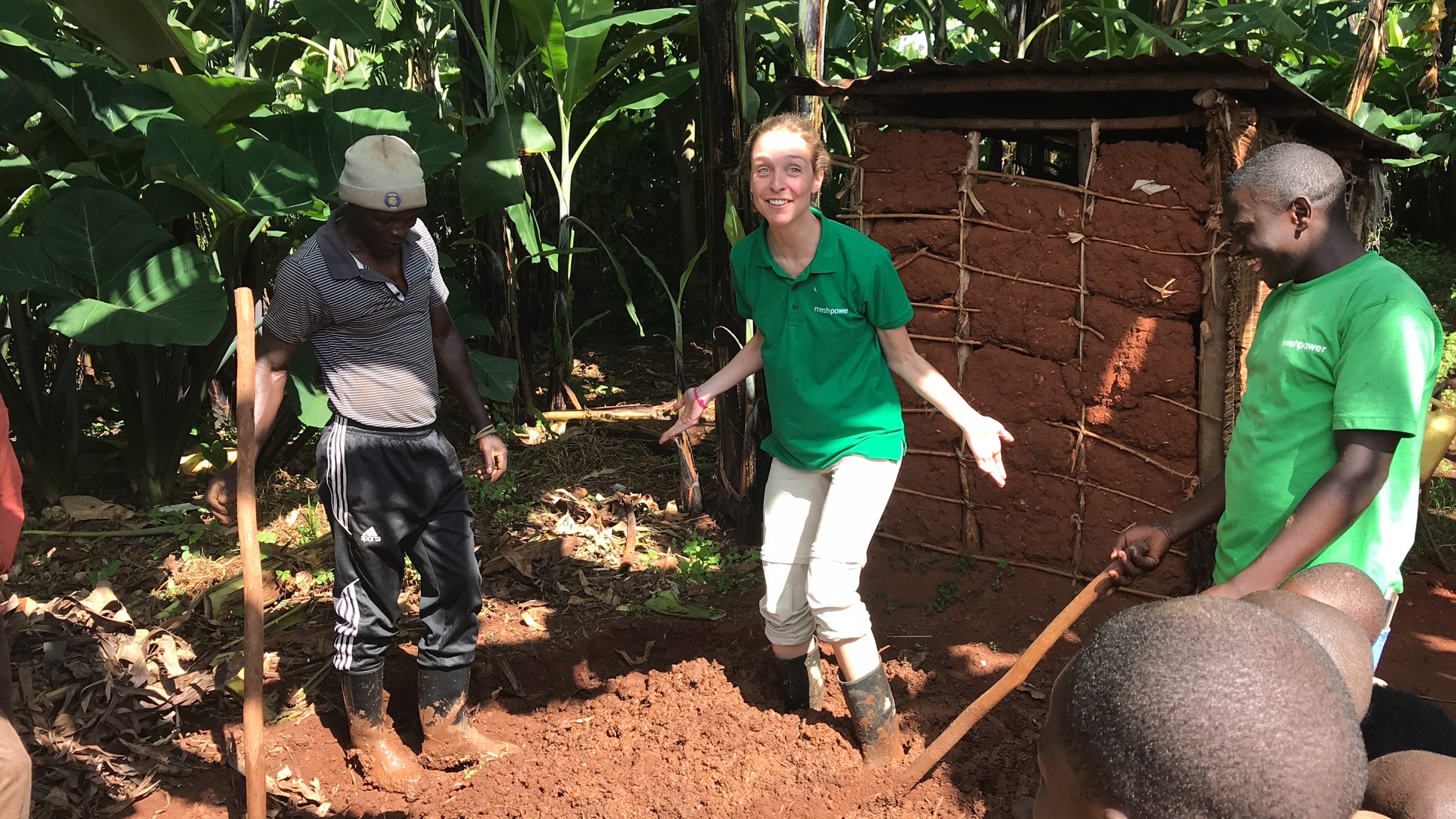
Even though living conditions have improved massively through the installation of MeshPower’s mini-grid, villages like the one I have visited for Umuganda are still living in very basic conditions with incomes that often just about cover the living costs of a family. This is being reflected by villagers often building latrines and other shared facilities on their own with wood and self-produced clay. Hence, for Umuganda our team was helping the village not only with cleaning and reconditioning some of the grid-related material, but also with renewing the surface of some of the clay huts. Any shyness or fear of the rural population and especially the children towards us foreigners was quickly receding when we started to get our hands dirty and often unsucessfully tried to learn how to make the clay stick to the walls.
Getting involved in some hands-on activity was definitely a welcoming change from my day-to-day work as a pro-bono consultant at MeshPower’s head office in Kigali, which included enhancing a financial model, developing a customer credit scoring system, or supporting with the application for grants. But even Kigali offered enough options to get involved in some volunteering opportunities besides work. Together with members of one of the local Rotaract Clubs, I visited a bed-bound genocide survivor in her tiny hut in one of the slum-like settlements that still make up parts of the city – supplying her with food and other essentials while listening to her heart-wrenching and inspiring story of how she was left to die severely insured while almost her entire family got killed, but never gave up and still has faith. Another time I supported them in the organisation of the Rwanda Finals for the East African Spelling Bee event, a competition for school children that started in 1925 in the US and awards the student who can spell most difficult English words correctly – many of which I myself did not know and would definitely not be able to spell correctly. The initiative aims at helping African students to improve their English vocabulary as well as build their confidence. Even though the participating children were mainly part of private schools, I was impressed to see the potential of the young Rwandan population. Nevertheless, with 64% of children having an incomplete primary education or no education at all, there is still a lot of work to do especially in rural areas.
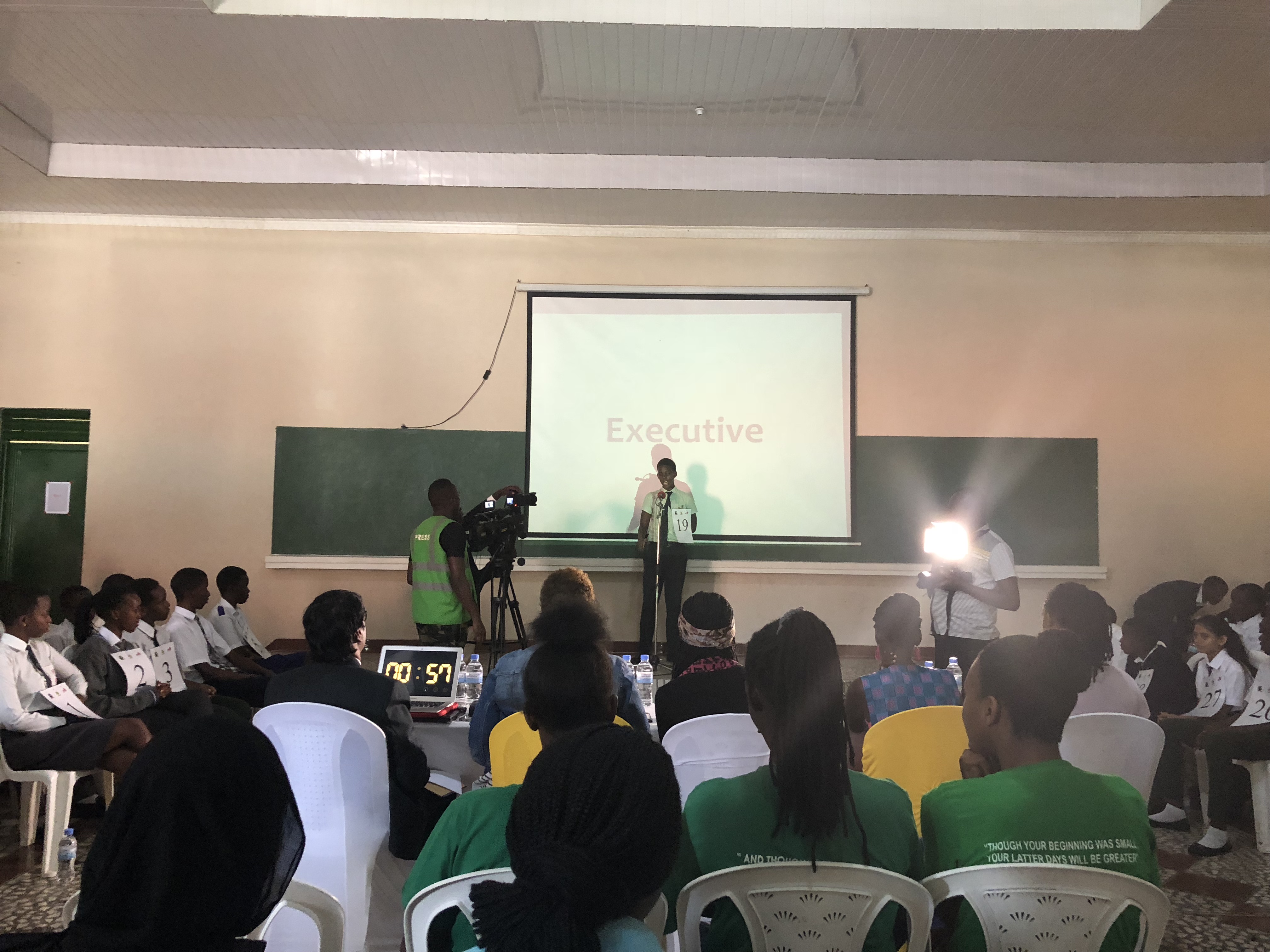
- Student spelling the word “Executive” at the Rwanda Finals of the East African Spelling Bee competition
Less than 1% of all youth goes beyond secondary education to study at one of Rwanda’s mainly private universities. Those who are fortunate enough to do so often face difficulties finding jobs after university despite being very smart and motivated due to the limited practical experience they are able to gain as part of their curriculum. I was lucky to cooperate with a highly engaged group of geography students from the University of Kigali, who helped me and a friend organise the first public Mapathon event in Kigali, where we taught over 50 participants how to map crisis-prone areas of the world for humanitarian organisations like Doctors Without Borders using satellite images and OpenStreetMap. With the effort of everyone, we helped UNHCR to map an area in northern Uganda where refugees from the DRC and South Sudan are supposed to be settled soon – allowing field surveyors to gain information on already existing and potential locations for water, sanitary, and shelter facilities. Thanks to our mappers in Kigali and other volunteers from around the world, locations of buildings, streets, and facilities are now viewable on OpenStreetMap compared to an almost empty Google Maps excerpt.

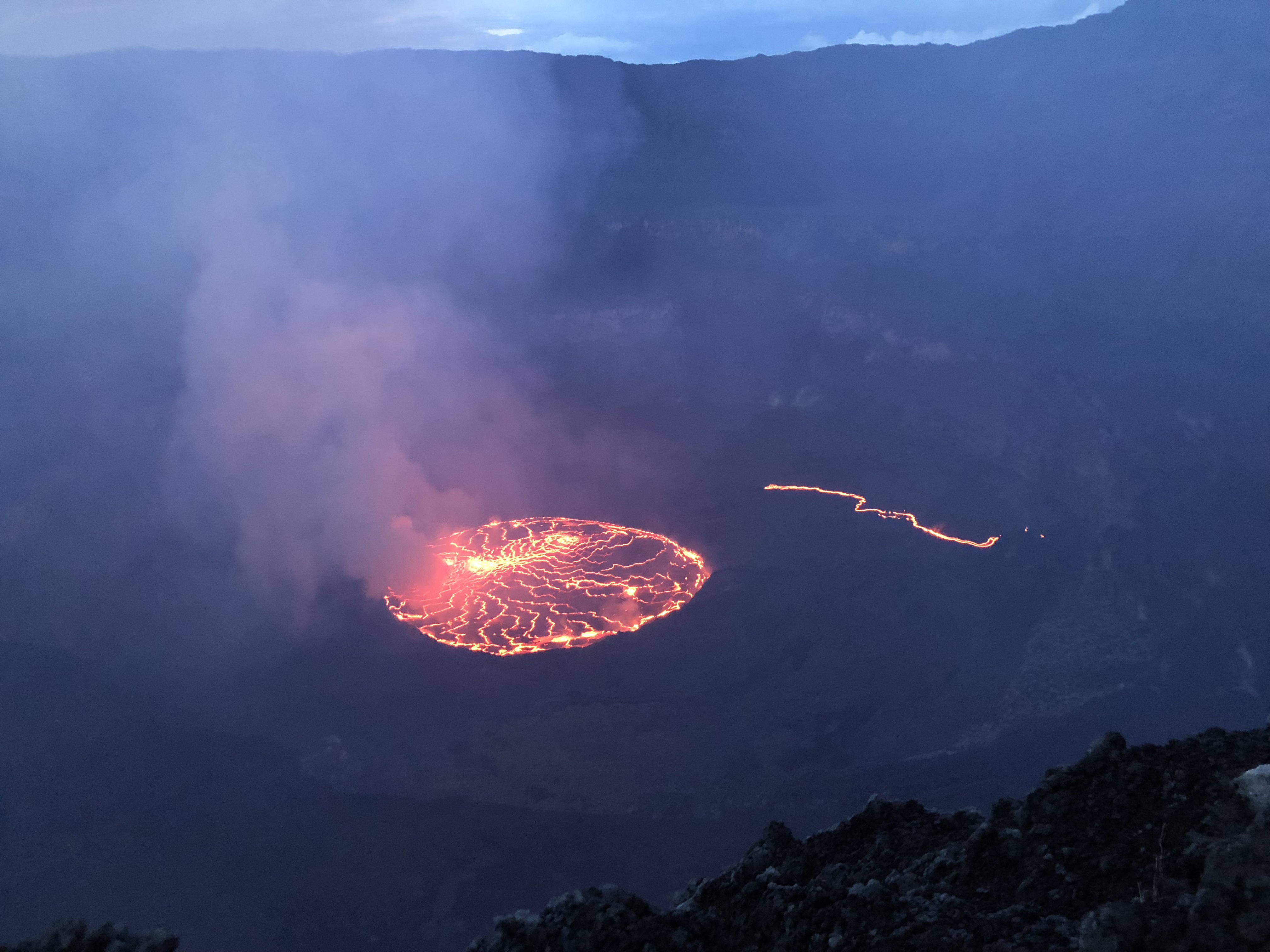
Besides my volunteering activities in and around the capital, I was trying to explore the country during weekend trips. Driving towards the northwest, the green hills covered by tea and coffee plantations – one of which, Sorwathe, offers factory tours and a guest house as a quick get-away from Kigali – merge into volcanic mountains that reach up to 4,500 meters and are covered with dense and humid rain forrest – home to the famous Mountain Gorillas. Non of the volcanic mountains on the Rwandan side are active any more, but Mount Nyiragongo just over the border to DRC is still active and features one of the largest lava lakes worldwide. Its last breakout in 2002 had devastating consequences to Goma, the border town closest to the volcano. Currently the area is not accessible as Virunga park closed due to recent security issues.
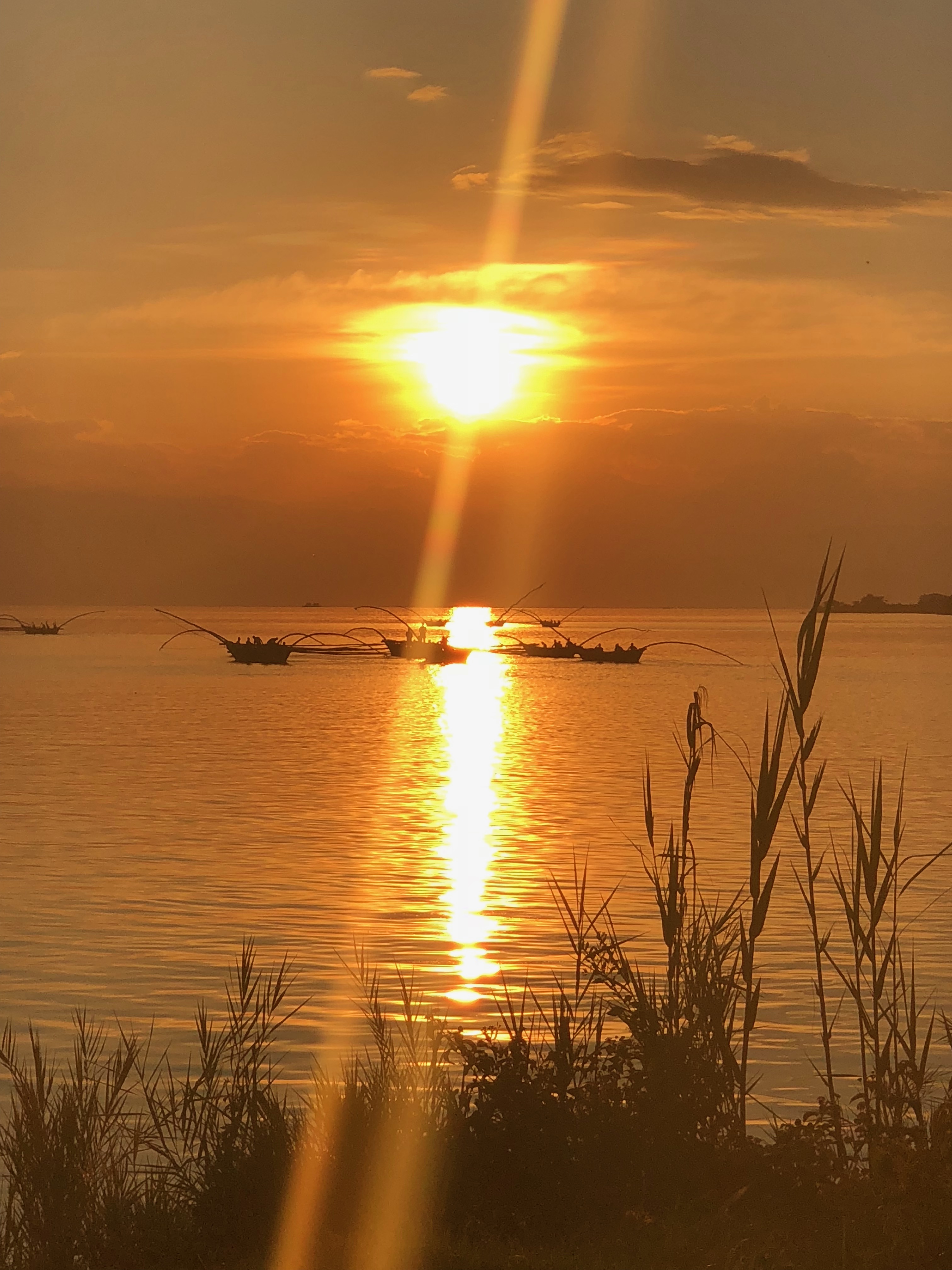
However, there are plenty of exciting activities in the area that do not require crossing over into politically unstable DRC. The border town on the Rwandan side, Gisenyi, Rwanda’s fifth largest city, offers a relaxing atmosphere with its beautiful lake-side hotels, cafes, and bars, as well as boat trips to islands or hot springs. Fishermen with traditional wooden boats tied together as triplets singing and chanting their way out from the villages as the sun sets to fish for sambaza, small sardines, transform the huge lake into a sea of stars from the lights they use during night to attract the fish. Although the lake is save for swimming due to the absenteeism of crocodiles or hippos, it is easy to catch a parasite – but that does not scare the majority of visitors away from taking a dip on one of the white beaches.
Further south along the river lies the small town of Kibuye, which is the calmer version of Gisenyi, great for a sporty weekend swimming, cycling, or hiking along the lake. When continuing to drive south, you will eventually get to Nyungwe Forest National Park that attracts with luxury lodges, chimpanzee tracking, and a canopy walk. To the east of the country an equally beautiful national park with an entirely different ecosystem, Akagera National Park, offers safaris to see giraffes, zebras, antelopes, hyenas, and even a few lions. Even though it might not be as spectacular in size and animal density as the game reserves of neighbouring country, it is definitely a hidden gem with affordable prices and the possibility to camp under the stars – likely without any other visitors around. Unfortunately, I have not been able to visit those two national parks yet, but I am sure I will be back to explore more of Rwanda’s beautiful countryside.

All in all, I had an amazing and very rewarding experience in this beautiful country Rwanda – definitely worth a visit beyond the standard tourist attractions. It is fascinating to see how the young generation is so full of ambition and is not letting their past define their possibilities for the future. If you are interested to read or see more from upcoming Rwandese, have a look at Natacha Karambizi’s short stories and opinions, the book ‘My Name is Life’ from Karen Bugingo, or photographer Jacques Nkinzingabo a founder of the Kigali Center for Photography.
I hope I was able to give you a glimpse into a country the majority of the world knows so little about and am happy to answer any questions you might have about it to the best of my ability.
 Maria Knodt
Leave a comment